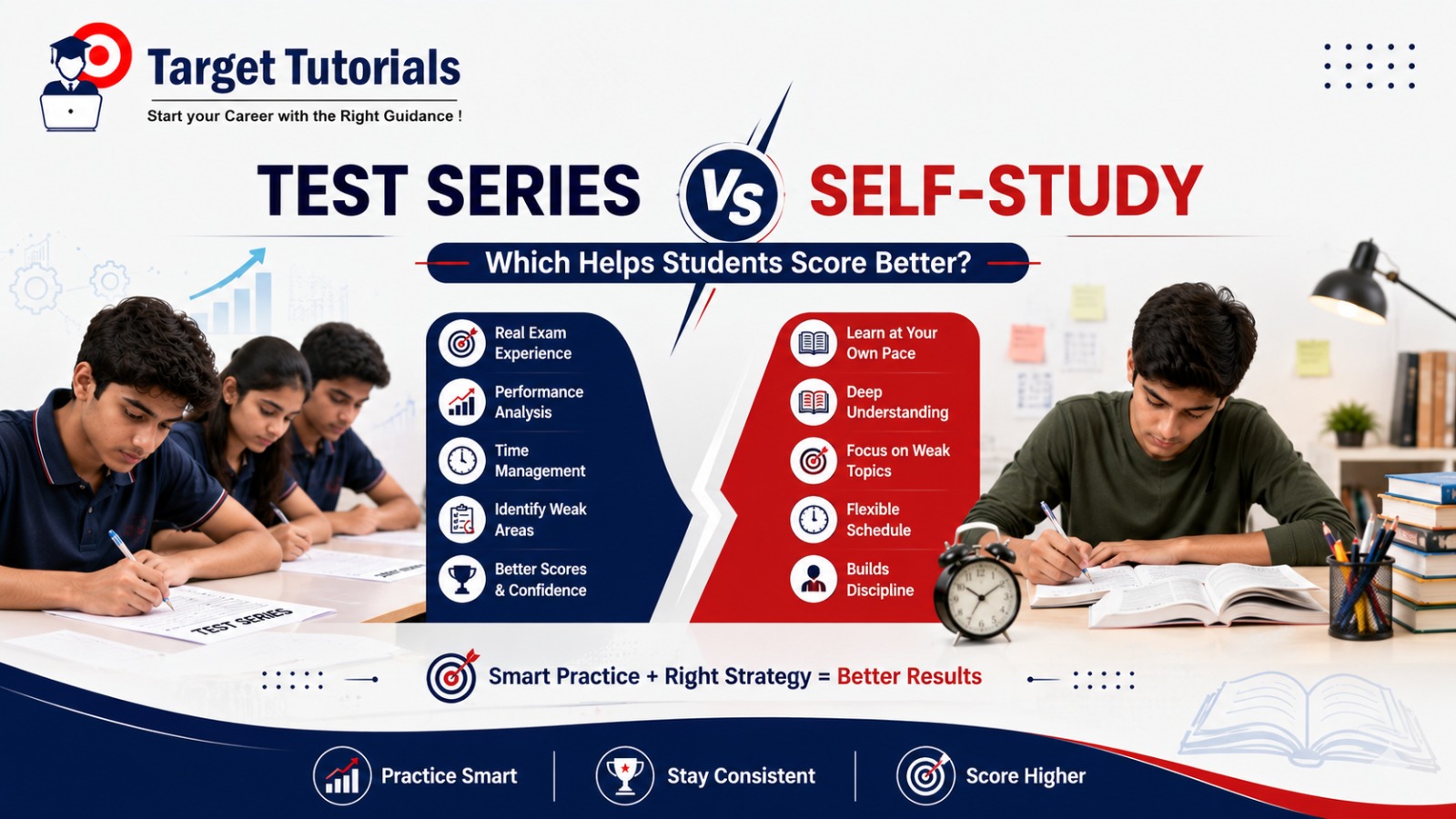
Every CBSE student wants one answer before exams: Should I focus on self-study or join a test series to score better? Parents often encourage self-study, while schools and coaching institutes emphasize mock tests and test series. The truth is that both methods are important, but they serve different purposes.
Self-study helps students learn concepts, while a test series helps them perform effectively in exams. Students who rely only on self-study may understand the syllabus but struggle with time management, revision, and exam pressure. On the other hand, students who attempt many tests without proper study may repeat mistakes and fail to build strong concepts.
This blog compares Test Series vs Self-Study in detail and explains which approach helps CBSE students score better in school exams and board examinations.
Understanding Self-Study

Self-study is the process of learning independently using textbooks, notes, reference books, videos, and practice questions. Students decide what to study, when to study, and how long to study.
Advantages of Self-Study
- Flexible schedule
- Personalized learning speed
- More time for difficult topics
- Better conceptual understanding
- Encourages independent thinking
- Develops concentration and discipline
Limitations of Self-Study
- No regular performance check
- Weak areas may remain unnoticed
- Difficult to maintain consistency
- Lack of exam-like practice
- Poor time-management training
- No comparative feedback
Self-study is excellent for learning, but it does not automatically guarantee high exam scores.
Understanding a Test Series
A test series is a structured set of chapter-wise, subject-wise, and full-length mock tests conducted regularly. It is designed according to the latest CBSE pattern and focuses on assessment and exam preparation.
Advantages of a Test Series
- Regular revision
- Performance analysis
- Identification of weak topics
- Time-bound practice
- Exam discipline
- Confidence building
- Familiarity with question patterns
Limitations of a Test Series
- Less flexibility
- Requires regular preparation
- Can create pressure if approached incorrectly
- Not sufficient without conceptual study
A test series improves exam performance, but it cannot replace proper learning.
The Fundamental Difference
The biggest mistake many students make is treating self-study and a test series as competing methods. In reality, they solve two different problems.
| Self-Study | Test Series |
| Builds concepts | Tests concepts |
| Improves understanding | Improves application |
| Flexible timing | Fixed timing |
| Learning-focused | Performance-focused |
| Individual pace | Exam pace |
| No pressure | Simulated exam pressure |
Think of self-study as practice sessions and a test series as the actual match preparation. A cricketer may practice batting for hours, but match performance improves only when he faces real bowlers under match conditions. Similarly, CBSE students need both learning and performance training.
Which Helps More in Scoring Better?
The answer depends on the stage of preparation.
During Concept Learning
In the early stage of preparation, self-study is more important. Students should focus on:
- NCERT textbooks
- Class notes
- Concept videos
- Solved examples
- Basic practice questions
Without strong concepts, test scores remain unstable.
During Revision
Once the syllabus is completed, a test series becomes more valuable because it helps students:
- Recall information quickly
- Solve questions accurately
- Improve writing speed
- Manage exam time
- Reduce silly mistakes
During the Final 2-3 Months Before Boards
At this stage, a combination works best:
- 60% test practice
- 40% targeted self-study
Students should analyze every test and revise weak chapters immediately.
What Happens When Students Choose Only Self-Study?
Many students study for long hours but avoid tests because they fear low marks. Common problems include:
- Unable to complete the paper on time
- Poor presentation in subjective answers
- Forgetting formulas during exams
- Panic in difficult sections
- Overestimating preparation level
For example, a student may know all Science chapters but still score less because answers are not written in the required CBSE format.
What Happens When Students Choose Only Test Series?
Some students attempt many mock tests without revising concepts. Their scores often stop improving because:
- Mistakes are repeated
- Weak chapters remain weak
- Conceptual gaps increase
- Learning becomes superficial
A test is useful only when followed by detailed analysis and correction.
Subject-Wise Comparison
Mathematics
More useful: Test Series (after concepts are clear)
- Speed matters.
- Accuracy matters.
- Repeated practice improves marks significantly.
Recommended: Daily problem-solving + weekly full-length mock.
Science
Best approach: Equal balance
- Self-study for concepts and diagrams
- Test series for application and writing practice
Social Science
More useful: Test Series during revision
- Helps with answer structure, keywords, and time management.
English
More useful: Test Series
- Improves writing skills, comprehension speed, and presentation.
Hindi/Sanskrit
Best approach: Self-study for grammar and literature + periodic tests.
Time Management: The Hidden Advantage of a Test Series
Board exams are not only knowledge tests; they are also time-management tests. Students often discover during mocks that:
- Section A takes longer than expected.
- Long answers consume too much time.
- Diagram drawing slows them down.
- Rechecking is impossible due to poor planning.
Regular timed tests train the brain to think and write within exam limits.
Simple Time-Management Strategy
For a 3-hour paper:
- First reading: 15 minutes
- Easy questions: 60 minutes
- Moderate questions: 70 minutes
- Difficult questions: 30 minutes
- Revision: 5-10 minutes
This strategy becomes effective only through repeated mock practice.
Confidence: Where the Real Difference Appears
Students who regularly attempt tests become familiar with:
- Exam atmosphere
- Stress levels
- Paper patterns
- Answer-writing expectations
As a result, they enter the board exam with confidence. Students who have never attempted full-length mocks often feel anxious even if they have studied well.
A Practical Example
Consider two Class 10 students.
Student A
- Studies 5 hours daily
- Rarely gives tests
Student B
- Studies 4 hours daily
- Gives one full mock every Sunday
- Reviews mistakes for 2 hours
After three months, Student B usually performs better because the preparation is continuously measured and corrected.
Ideal Weekly Schedule for CBSE Students
Monday to Friday
- 2-3 hours self-study
- Concept learning
- Homework and practice
Saturday
- Revision of the week
- Formula and short-note review
Sunday
- One full-length test
- Detailed error analysis
This schedule keeps both learning and assessment balanced.
How to Analyze a Test Properly
A test is wasted if students only check marks. After every test, create three lists.
1. Concept Errors
Questions you could not solve because the concept was weak.
2. Careless Errors
Calculation mistakes, skipped steps, spelling mistakes, wrong question numbers.
3. Time Errors
Questions left due to poor time allocation.
Work on these three areas before the next test. This single habit can improve scores dramatically.
Recommended Preparation by Class
Class 9
- 70% self-study
- 30% tests
Focus on building fundamentals.
Class 10
- 60% self-study
- 40% tests
- Increase mocks after syllabus completion.
Class 11
- Strong emphasis on conceptual self-study.
Class 12
- Start tests early and gradually increase frequency before boards.
Common Myths
Myth 1: “More study hours mean better marks.”
Quality matters more than quantity.
Myth 2: “Mock tests are only for toppers.”
Average students often benefit the most from regular tests.
Myth 3: “Low mock marks are a bad sign.”
Low marks reveal weaknesses early, which is actually helpful.
Myth 4: “I will start tests after finishing the entire syllabus.”
Start chapter-wise tests much earlier.
The Best Strategy for Scoring 90%+ in CBSE
Step 1: Learn
Read NCERT carefully and understand every concept.
Step 2: Practice
Solve textbook exercises and previous-year questions.
Step 3: Test
Attempt timed chapter-wise and full-length mocks.
Step 4: Analyze
Identify mistakes and weak topics.
Step 5: Revise
Re-study weak chapters and attempt another test.
This cycle should continue until the exam.
Final Verdict
So, Test Series vs Self-Study — which is better?
- Self-study is better for learning.
- Test series is better for scoring.
- The highest marks come from combining both.
A student who studies independently and regularly tests that knowledge develops concepts, speed, accuracy, confidence, and exam temperament together. That is the combination most successful CBSE toppers follow.
If your goal is simply to complete the syllabus, self-study may be enough. If your goal is to maximize board marks, include a structured test series in your preparation plan from the revision stage onward.
About Target Tutorials
Target Tutorials is a trusted coaching institute focused on helping CBSE students build strong concepts, improve academic performance, and prepare effectively for school and board examinations. The institute provides structured learning, regular tests, revision support, and personalized guidance for students from Classes 7 to 10, helping them develop confidence and score better in exams.
Explore more educational blogs on Target Tutorials for practical study tips, board exam preparation strategies, mock test guidance, subject-wise improvement techniques, and time-management ideas designed specifically for CBSE students and parents.
FAQs
1. Is self-study enough to score 90% in CBSE?
Yes, self-study can be enough if concepts are strong, revision is regular, and students practice previous-year papers and mock tests consistently.
2. When should Class 10 students start a test series?
Students should begin chapter-wise tests after completing each chapter and start full-length mock tests once 60-70% of the syllabus is completed.
3. How many mock tests should I attempt before board exams?
Attempt at least 10-15 full-length mock tests before the board exam, along with chapter-wise practice tests.
4. What should I do after getting low marks in a mock test?
Analyze mistakes, revise weak topics, solve similar questions again, and attempt another test within a few days.
5. Which is more important in the last month before boards?
In the final month, mock tests, revision, and error correction become more important than learning entirely new topics.