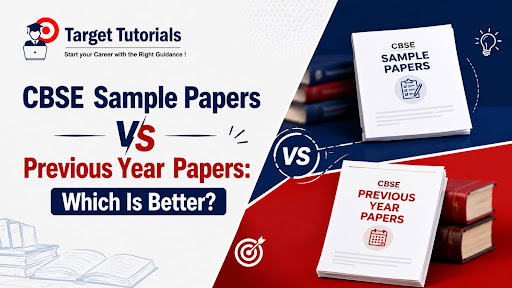
When preparing for CBSE board exams, students often wonder about CBSE Sample Papers vs Previous Year Papers and which one can help them score better. Both are valuable preparation resources, but they serve different purposes. Sample papers help students understand the latest exam pattern, question format, and marking scheme, while previous year papers show how questions have actually appeared in past board examinations.
Choosing between them does not have to be difficult. In fact, the best preparation strategy is to use both at the right stage of your revision. Understanding their differences can help you plan your study time more effectively and enter the examination hall with greater confidence.
What Are CBSE Sample Papers?
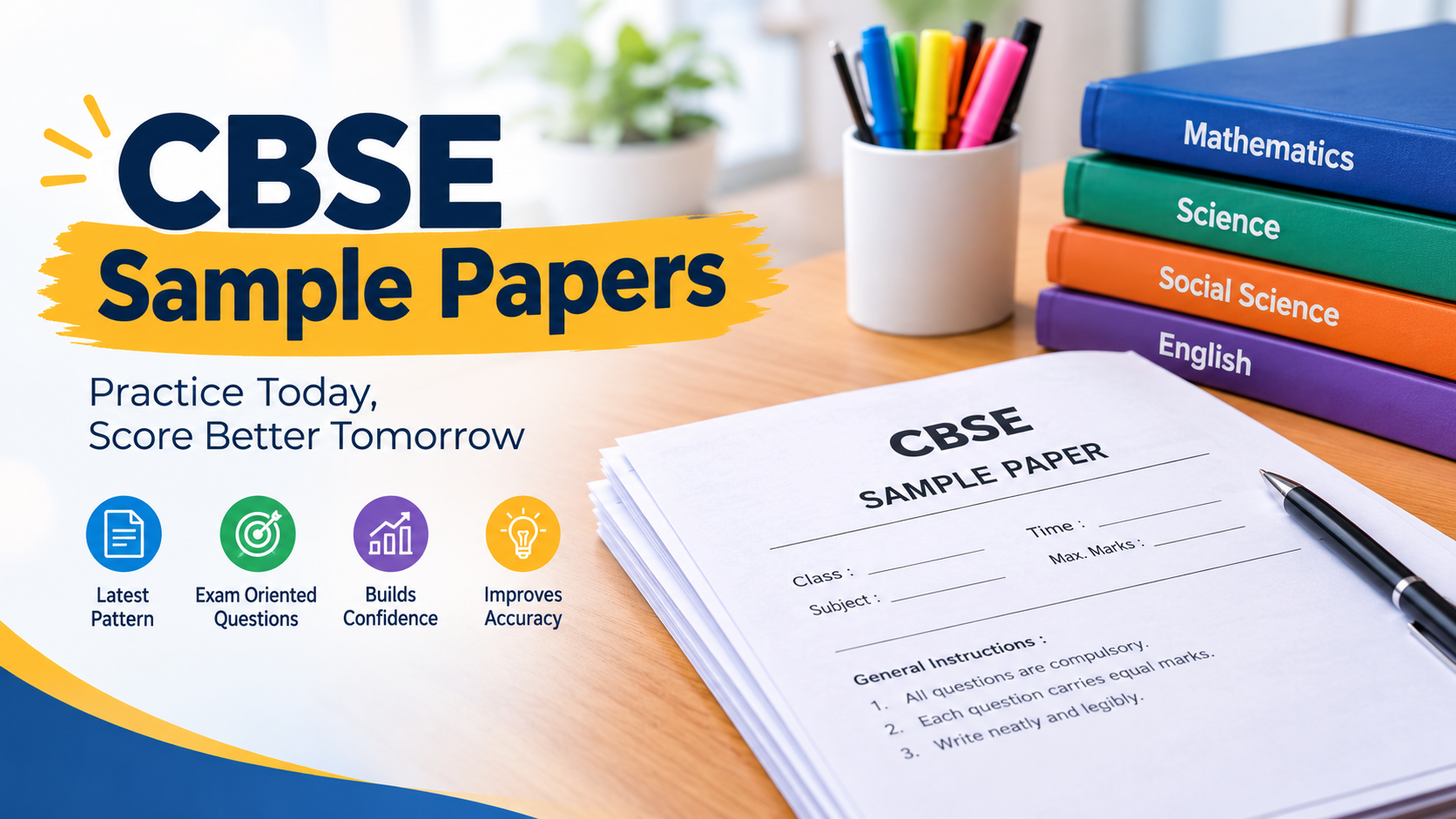
CBSE sample papers are practice question papers designed according to the examination pattern and syllabus. They are particularly useful when students want to become familiar with the latest structure of the exam.
Sample papers generally include different types of questions, such as:
- Multiple-choice questions
- Assertion and reason questions
- Case-based questions
- Competency-based questions
- Short-answer questions
- Long-answer questions
They also provide students with an opportunity to practice questions within a fixed time limit. Since CBSE has increasingly focused on application-based and competency-based assessment, sample papers can help students understand how concepts may be tested in different ways.
What Are Previous Year Papers?
Previous year papers are actual question papers from earlier CBSE examinations. They allow students to see what types of questions have been asked in real board exams.
By solving these papers, students can understand:
- The level of questions asked in the examination
- Commonly tested concepts
- The distribution of questions
- The difficulty level of different sections
- How much time is required to complete a paper
- How questions can be framed from important chapters
Previous year papers are especially helpful during revision because they give students a realistic idea of what an actual board examination feels like.
CBSE Sample Papers vs Previous Year Papers: Key Difference
The biggest difference between sample papers and previous year papers is their purpose.
Sample papers are mainly designed to prepare students for the current or expected examination pattern, whereas previous year papers help students understand the real examination experience and question trends.
| Factor | CBSE Sample Papers | Previous Year Papers |
| Purpose | Practice the latest pattern | Understand past board exams |
| Question Style | Based on expected/current format | Asked in actual exams |
| Latest Pattern | Usually reflects recent changes | May follow older patterns |
| Exam Practice | Excellent | Excellent |
| Trend Analysis | Moderate | Very useful |
| Time Management | Very useful | Very useful |
| Concept Revision | Useful | Very useful |
| Difficulty Understanding | Good | Realistic |
| Best Use | Current exam preparation | Revision and analysis |
Both resources complement each other rather than competing with one another.
Benefits of Solving CBSE Sample Papers
1. Understand the Latest Exam Pattern
One of the biggest advantages of sample papers is that they help students understand the current question paper structure. If CBSE introduces changes in question types, marks distribution, or assessment style, sample papers can help students prepare accordingly.
This is important because relying only on old papers may not give students an accurate picture of the latest examination format.
2. Practice Competency-Based Questions
Modern CBSE examinations include questions that test understanding and application rather than simple memorisation.
Sample papers can expose students to case-based, assertion-reasoning, competency-based, and application-oriented questions. Regular practice makes these formats less intimidating.
3. Improve Time Management
A student may know all the answers but still lose marks if they cannot complete the paper on time.
Solving sample papers under examination conditions helps students learn how much time to spend on different sections. It also helps them identify questions that should be attempted first.
4. Identify Weak Areas
After completing a sample paper, students can analyse their mistakes. For example, a student may discover that they understand a chapter but struggle with application-based questions.
This type of analysis helps students focus their revision instead of spending equal time on every topic.
5. Build Confidence
Regular practice reduces exam anxiety. When students become familiar with different question formats, they are less likely to feel nervous when they see a similar format in the actual examination.
Benefits of Solving Previous Year Papers
1. Understand Real Board Exam Questions
Previous year papers are based on actual examinations, making them one of the most practical resources for board preparation.
Students can see how concepts are converted into questions and understand the level of answers expected in the exam.
2. Identify Repeated Concepts
Questions may not always be repeated word-for-word, but important concepts and chapters can appear regularly.
By analysing several previous year papers, students can identify topics that have received attention over the years. This does not mean students should study only repeated questions, but it can help them prioritise revision.
3. Understand Question Difficulty
Textbook questions and classroom exercises may not always reflect the exact difficulty of a board examination.
Previous year papers give students a better understanding of how easy, moderate, and challenging questions are combined in an actual paper.
4. Improve Answer Writing
Board examinations require students to present answers clearly and appropriately according to the marks allotted.
Previous year papers allow students to practise writing answers within the expected word limit and structure. This is particularly useful for subjects that include descriptive answers.
5. Test Overall Preparation
Once a student has completed most of the syllabus, previous year papers can be used as full-length tests.
Students can attempt a paper without referring to notes, set a timer, and evaluate their performance afterwards. This provides a realistic assessment of their preparation.
Which Is Better: Sample Papers or Previous Year Papers?
If you have to choose only one, CBSE Sample Papers are generally more useful for understanding the latest exam pattern, while Previous Year Papers are better for understanding real board examination trends.
However, choosing only one is not the ideal approach.
For example, a student preparing for an upcoming board exam should first understand the latest syllabus and question paper pattern. Sample papers can then be used to practise the current style of questions.
After that, previous year papers can help students understand how concepts have been tested in actual examinations.
Therefore, instead of asking which one is better, students should ask when to use each one.
When Should Students Solve Sample Papers?
Sample papers are particularly useful during the final phase of preparation.
Students can start solving them after completing a major portion of the syllabus. They should gradually move from chapter-wise practice to full-length papers.
A useful approach is:
Complete syllabus → Revise concepts → Solve sample papers → Analyse mistakes → Revise weak topics → Take full-length tests
Students should not simply solve one paper after another. The analysis after every paper is equally important.
When Should Students Solve Previous Year Papers?
Previous year papers can be introduced once students have a good understanding of the syllabus.
They are particularly effective during revision because students can compare their performance across different years and identify frequently tested concepts.
For example, if a student is preparing for Mathematics, they can solve several previous year papers and categorise their mistakes into:
- Calculation errors
- Formula mistakes
- Conceptual mistakes
- Misreading questions
- Time-management problems
- Presentation issues
This makes revision more targeted and productive.
The Best Strategy: Use Both
Instead of choosing between the two, students should combine sample papers and previous year papers.
Step 1: Complete the Syllabus
Before attempting full papers, make sure the important concepts from the syllabus have been covered.
Step 2: Revise Chapter-Wise
Revise formulas, definitions, concepts, diagrams, examples, and important points according to the subject.
Step 3: Solve Previous Year Papers
Begin with previous year papers to understand the actual examination style and identify commonly tested areas.
Step 4: Practise Sample Papers
Move towards sample papers to become comfortable with the latest question formats and competency-based questions.
Step 5: Attempt Papers Under Exam Conditions
Keep your books and notes away. Sit for the complete duration and attempt the paper just as you would in the board examination.
Step 6: Analyse Every Mistake
Do not stop after checking the marks. Find out why you lost each mark.
Ask yourself:
- Did I misunderstand the question?
- Did I forget a concept?
- Did I make a calculation mistake?
- Did I spend too much time on one question?
- Was my answer poorly structured?
Step 7: Repeat the Process
Use your mistakes to plan your next revision session. This turns every practice paper into a learning exercise.
Common Mistakes Students Should Avoid
While solving papers, students often make a few common mistakes.
Solving Papers Without Checking Mistakes
Simply completing ten papers is not enough. Students should spend time reviewing incorrect answers and understanding the reason behind each mistake.
Memorising Previous Year Questions
Previous year papers should not be treated as a list of questions to memorise. The same concept can be asked in a completely different way.
Ignoring the Latest Pattern
Old papers can become less useful if the examination pattern has changed. Students should always stay updated with the current CBSE syllabus and paper structure.
Practising Without a Timer
Board examinations are time-bound. Solving papers without a time limit does not provide a realistic measure of exam performance.
Focusing Only on Easy Questions
Students should practise different difficulty levels. This prepares them to handle unexpected or challenging questions calmly during the examination.
How Many Papers Should You Solve?
There is no fixed number that guarantees good marks. Quality matters more than quantity.
A student who carefully analyses five papers may benefit more than someone who solves fifteen papers without reviewing mistakes.
A practical target can be to solve several previous year papers along with multiple latest sample papers, depending on the time available and the student’s preparation level.
The goal should be to improve after every paper rather than simply increase the number of papers completed.
Final Verdict: Which One Should You Choose?
When comparing CBSE Sample Papers vs Previous Year Papers, there is no single winner.
Sample papers are better for understanding the latest exam format, practising new question types, and preparing for competency-based questions.
Previous year papers are better for understanding real board exam questions, analysing question trends, improving answer writing, and testing overall preparation.
The smartest strategy is to use both. Start with previous year papers to understand the examination experience and important concepts, then use sample papers to adapt to the latest pattern and practise different question formats.
Ultimately, papers are most effective when students do more than just solve them. Solve, analyse, identify mistakes, revise, and solve again. This approach can improve accuracy, time management, confidence, and overall exam readiness.
For students preparing for CBSE board examinations, the combination of conceptual understanding, regular revision, previous year papers, and latest sample papers can create a much stronger preparation strategy than relying on any single resource.
Target Tutorials is a trusted coaching institute in Pune, dedicated to helping students from 7th to 10th standard achieve strong academic performance. With experienced faculty, concept-focused teaching, personalized attention, regular assessments, and well-structured study materials, Target Tutorials helps students strengthen their fundamentals and prepare confidently for their school examinations.
The institute focuses on creating a supportive learning environment where students can understand concepts clearly, improve their problem-solving skills, and build confidence. With a systematic approach to learning and continuous guidance, Target Tutorials aims to help every student reach their academic potential.
FAQs – CBSE Sample Papers vs Previous Year Papers
1. Are CBSE Sample Papers better than Previous Year Papers?
Both are useful for different purposes. CBSE Sample Papers help students understand the latest exam pattern and question format, while Previous Year Papers help identify recurring question types and understand the actual difficulty level. CBSE officially provides both resources.
2. When should students solve CBSE Sample Papers?
Students should ideally solve sample papers after completing most of the syllabus. They can then attempt them under timed conditions to improve speed, accuracy, and exam readiness.
3. Why are Previous Year Papers important for CBSE preparation?
Previous Year Papers help students understand how questions have been asked in actual board examinations. They can also help students identify commonly tested concepts and become familiar with the structure of real exam papers.
4. Should students solve both Sample Papers and Previous Year Papers?
Yes. Using both provides more complete preparation. Students can begin with Previous Year Papers to understand past exam trends and then use the latest Sample Papers to practice the expected pattern and question formats.
5. What is the best way to use CBSE Sample Papers and Previous Year Papers?
Students should solve each paper within the prescribed time, check their answers using the official marking scheme where available, identify mistakes, and revise weak topics. CBSE publishes sample papers along with marking schemes for different session.